Reader Eileen contacted us this week with an inquiry about her Bakelite handles emitting a foul odor:
I use my Revere pots and pans daily. Today, while making my younger children mac n’ cheese, the handle to the pot started to melt. The chemical smell caused us to evacuate the house for several hours.
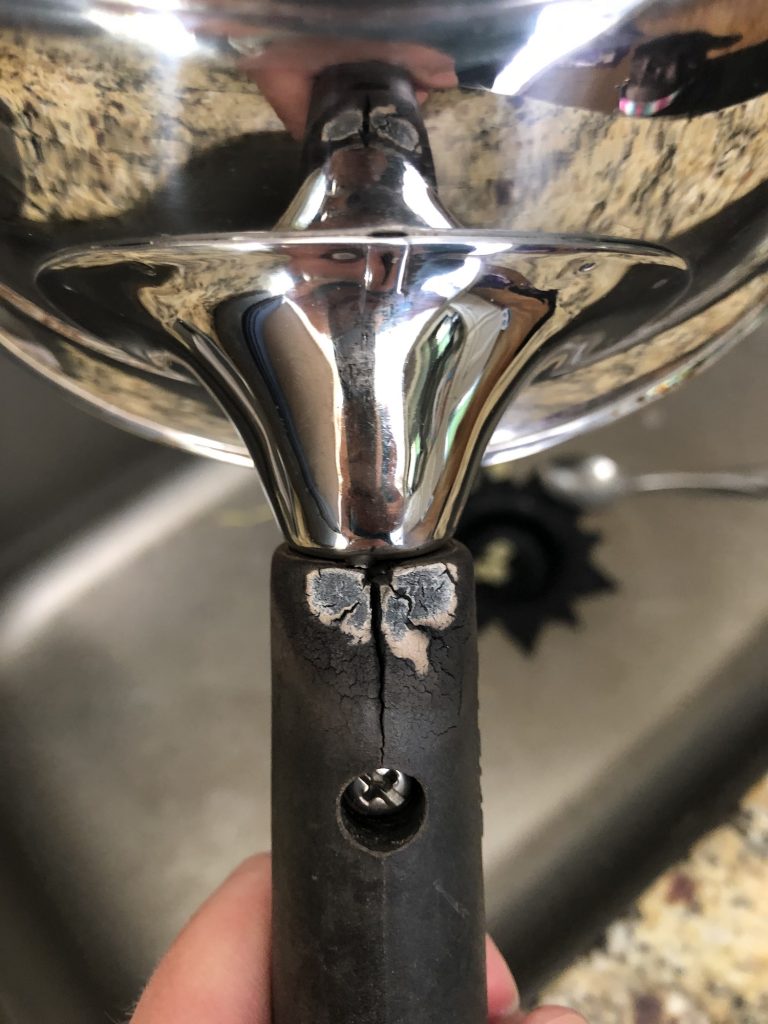
This presents a good opportunity to talk about safely using cookware with Bakelite handles.
The biggest danger to Bakelite handles is a gas stove. If a small pan is put on a large burner such that the flames, or the heat licks up the sides, it will cause the Bakelite to fail and emit this foul odor. Bakelite is a phenolic plastic; it doesn’t melt when overheated, it breaks down into its constituent parts, one of which is formaldehyde, which is the foul odor Eileen smelled. Despite the potential risk for this type of failure, we hear very few reports of this type of problem.
However, one issue is that, as Bakelite becomes older and damaged, it will fail through overheating much easier. Repeated washes in a dishwasher can cause damage that will make Bakelite much more susceptible to overheating. We did a dishwasher test and have shown that it doesn’t take a lot of repeating washings in the dishwasher for the handles to show visible discoloration, a prelude to the type of damage that can make them more sensitive to overheating.
The other risk to Bakelite is using pieces with Bakelite in an oven. You might think a Dutch oven was intended for the oven, and when Revere Ware first started selling their iconic cookware they did offer it as oven safe. But some time later they reversed their position and no-longer suggested it was such.
Bakelite is safe up to 35o degrees F, for a limited time. But modern ovens can often have hotter spots within them, especially when they are heating up. We don’t offer our parts as oven or dishwasher safe.
So our three safety tips for the day for cookware with Bakelite handles are:
- Never use them in an oven
- Wash them by hand, not in a dishwasher
- Take care when using them with a gas stove, not to turn the gas up too high
I totally agree! Thank you for your educational review! Love these pots/pans…amazing quality. My food heats evenly and tastes different then others I had attempted to try throughout the years. I’ve been a collector now for over 30 years. Thank you for recognizing how beautiful this cookware is and the preservation of its technological ingenious quality & unique characteristics…Nothing is better then revere ware copper clad! Nothing comes close in the market today.
I Agree!
I’ve used my Revere copper bottom cookware almost daily for a little over 50 years!
They’ve been through a lot; burned on food, being dropped and even played with by a toddler.
They still look great; even with the scratches of use.
Even the Bakelite handles have weathered well.
(is there a product out there that will refurbish Bakelite?)
No product, but you can sand the Bakelite with sandpaper, using ever finer grits, to get the shine back. But wear a mask as older Bakelite had asbestos in it.
To Revere Ware parts, with my copper bottom pots and pans that have the stamped in logo, I guess that means they were made in the late 60’s up to 1974 so that means the bakelite handles have asbestos? The handles are aged so does it get to be an exposure my merely getting on hands then in food?
Asbestos in a hard Revere Ware handle is considered “encapsulated asbestos.” That means it is fully contained inside another material and can not become airborne. Asbestos only becomes dangerous when (a) airborne (b) is breathed into the lungs where it becomes embedded, and (c) exposure is repeated and long-term. So you have nothing to worry about the asbestos fibers inside the Bakelite.